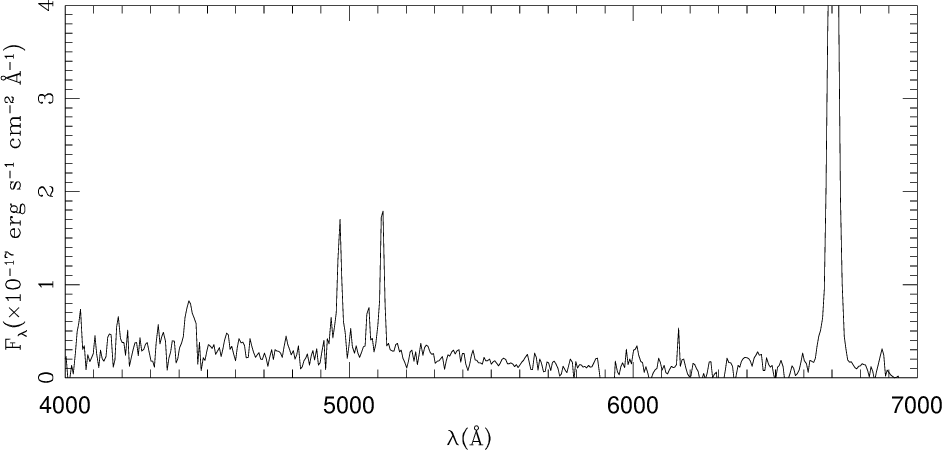
SN 1988Z was a prototypical type IIn supernova event in the equatorial constellation of Leo. The apparent host is an irregular galaxy with the designation MCG 03-28-22. It has a redshift of z equal to 0.0225. This was a very luminous supernova that faded unusually slowly and has remained detectable three decades after the event. It is one of the most radio and X-ray luminous supernova ever detected, and it has been extensively studied.
Observations
This event was discovered independently, both by C. Pollas at the Côte d'Azur Observatory on a photographic plate taken December 12, 1988, and by G. Candeo at the Asiago Astrophysical Observatory from a plate taken December 14. The supernova was already past maximum when it was discovered. A spectrum taken December 17 showed this was most likely a type II supernova.
This supernova displayed a number of unusual characteristics. It was unusually bright at maximum and showed very slow fading. There were strong, narrow emission lines caused by thick circumstellar material. Unlike a typical type II supernova, no P Cygni profiles or absorption lines were observed. Emission lines of neutral helium were also visible. The spectral lines displayed a complex structure that evolved over time. Decline in the Hydrogen-alpha line strength was unusually slow and lacked an explanation in terms of radioactive decay. The overall picture suggested interaction between the supernova ejecta and a dense circumstellar medium.
A year after the event, radio emission from the supernova was detected using the Very Large Array. The host galaxy shows a redshift of z equal to 0.022, making this the most distant radio supernova detected at that time. It was also one of the most luminous radio supernova discovered. The radio properties indicated a very massive progenitor star in the range of 20–30 M☉. In the late evolutionary stages of the star, it underwent a high rate of mass loss on the order of 10−4 M☉·yr−1, which created a dense circumstellar cocoon. In 1996, X-ray emission from the supernova was detected by ROSAT, making it the most distant supernova to be detected in this band. The estimated X-ray luminosity was 1041 erg·s−1, which is consistent with a supernova event within dense circumstellar material.
Most studies now favor a model of a very massive progenitor that ejected up to 10 M☉ at a rate of around 10−3 M☉·yr−1 for a period of about 10,000 years prior to the explosion. The mass loss rate ramped up during the final millennium prior to core collapse.
References
Further reading