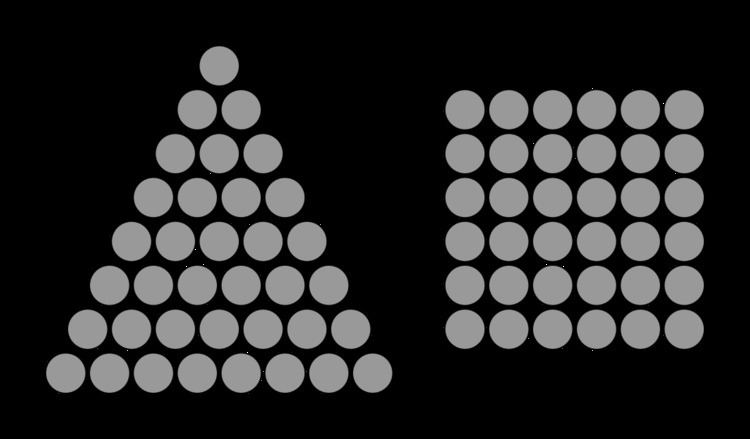
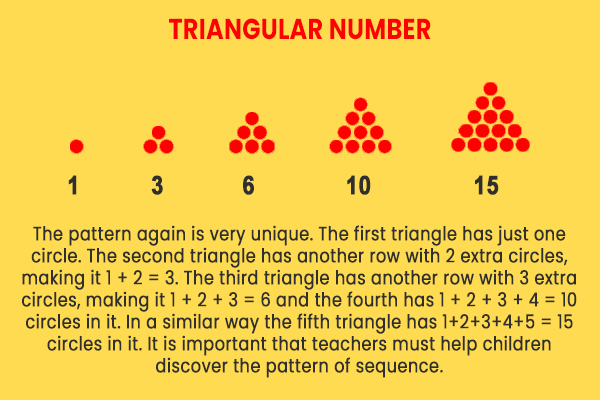
In mathematics, a square triangular number (or triangular square number) is a number which is both a triangular number and a square number. There are infinitely many square triangular numbers; the first few are:
Solution as a Pell equation
Write for the th square triangular number, and write and for the sides of the corresponding square and triangle, so that
Define the triangular root of a triangular number to be . From this definition and the quadratic formula,
Therefore, is triangular ( is an integer) if and only if is square. Consequently, a square number is also triangular if and only if is square, that is, there are numbers and such that . This is an instance of the Pell equation with . All Pell equations have the trivial solution for any ; this is called the zeroth solution, and indexed as . If denotes the th nontrivial solution to any Pell equation for a particular , it can be shown by the method of descent that the next solution is
Hence there are infinitely many solutions to any Pell equation for which there is one non-trivial one, which is true whenever is not a square. The first non-trivial solution when is easy to find: it is . A solution to the Pell equation for yields a square triangular number and its square and triangular roots as follows:
Hence, the first square triangular number, derived from , is , and the next, derived from , is .
The sequences , and are the OEIS sequences OEIS: A001110, OEIS: A001109, and OEIS: A001108 respectively.
Explicit formula
In 1778 Leonhard Euler determined the explicit formula: 12–13
Other equivalent formulas (obtained by expanding this formula) that may be convenient include
The corresponding explicit formulas for and are:: 13
Recurrence relations
The solution to the Pell equation can be expressed as a recurrence relation for the equation's solutions. This can be translated into recurrence equations that directly express the square triangular numbers, as well as the sides of the square and triangle involved. We have: (12)
We have: 13
Other characterizations
All square triangular numbers have the form , where is a convergent to the continued fraction expansion of , the square root of 2.
A. V. Sylwester gave a short proof that there are infinitely many square triangular numbers: If the th triangular number is square, then so is the larger th triangular number, since:
The left hand side of this equation is in the form of a triangular number, and as the product of three squares, the right hand side is square.
The generating function for the square triangular numbers is:
See also
- Cannonball problem, on numbers that are simultaneously square and square pyramidal
- Sixth power, numbers that are simultaneously square and cubical
Notes
External links
- Triangular numbers that are also square at cut-the-knot
- Weisstein, Eric W. "Square Triangular Number". MathWorld.
- Michael Dummett's solution